San Quentin's First Bachelor's Degree Class Opens in a $239 Million Campus
For most of its 170 years, San Quentin has been the place California sent people to be locked away. This week it became something closer to a college campus, with a bachelor's degree program of its own. On Thursday, October 22, the state welcomed the first cohort of 34 incarcerated students into a Cal State LA bachelor's program taught in person inside the prison's new Learning Center, a $239 million building with classrooms, an open-stack library and media studios that look out over San Francisco Bay.
It is the first bachelor's degree program offered at San Quentin, which the state has been remaking since 2023 as a rehabilitation center modeled on Scandinavian prisons. For the Bay Area, which has long sent volunteers, coders and journalists through San Quentin's gates, the degree is a test of whether the most ambitious prison education experiment in the country can produce graduates, jobs and lower recidivism.

A degree program starts inside the walls
The new cohort is studying for a Bachelor of Arts in liberal studies through Cal State LA's Prison Graduation Initiative, a 21-month program taught by California State University professors on site rather than by correspondence or video. The inaugural class is scheduled to graduate in May 2028. Cal State East Bay and San Francisco State are helping train Bay Area faculty to teach in the program.
Cal State LA started the initiative in 2016 at California State Prison, Los Angeles County, in Lancaster, as the first in-person bachelor's completion program inside a California state prison. It has since expanded to the California Institution for Men and the California Institution for Women in Chino, and has graduated more than 70 students. San Quentin is its fourth site.
"By expanding access to college inside our correctional facilities, we're strengthening rehabilitation," Governor Gavin Newsom said in a statement announcing the cohort.
"We are proud to partner with CDCR to bring Cal State LA's educational mission to San Quentin," Cal State LA President Berenecea Johnson Eanes said in the same announcement.
Inside the $239 million Learning Center
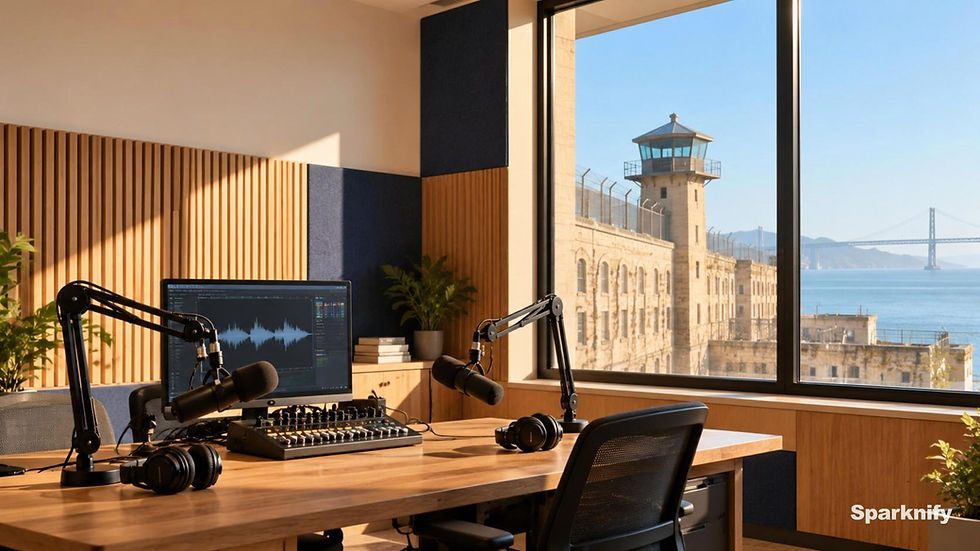
The classes meet in the San Quentin Learning Center, an 81,000-square-foot building that opened this year after 18 months of construction. Governor Newsom cut the ribbon in February, and the building has been in use since May. It holds classrooms, a technology and media hub with podcast and recording studios, a newsroom, a re-entry hub, outdoor gathering areas and a library where students can browse the stacks themselves, a freedom most prison libraries do not allow.
The state says weekly library checkouts have risen 400 percent since the building opened. The center now serves 432 students in adult basic and secondary education programs and 495 college students, including the new bachelor's cohort and students at Mount Tamalpais College, the tuition-free liberal arts college inside San Quentin that won accreditation in 2022 and grants associate degrees.
For many of the men, the view was the first thing they noticed. Some had not seen the bay in 20 or 30 years, and the first visits were emotional, Josh Henderson, San Quentin's principal of educational programs, said during a tour of the center.
What the numbers say about college in prison
California now runs bachelor's degree programs at 12 of its prisons through partnerships with the Cal State and University of California systems, all at no cost to students. The state's corrections department counts 9,966 incarcerated people working toward associate degrees, 451 toward bachelor's degrees and 48 toward master's degrees. Twenty-nine institutions offer face-to-face college programs, and every state prison offers community college courses by distance learning or correspondence.
The state's case for the spending rests on what happens after release. Corrections figures show that 81.5 percent of people who earned rehabilitation achievement credits stayed conviction-free three years after release, compared with 66.7 percent of people in general rehabilitative programming. A Public Policy Institute of California report found that incarcerated people who took college courses were 31 percent more likely to have jobs after release.
"Higher education is consistently proven to be one of the strongest predictors of successful re-entry," CDCR Secretary Jeff Macomber said in the announcement.
The announcement also tied the program to a broader public safety record. California's 2025 crime data showed homicide down 18.6 percent from 2024, robbery down 19.9 percent and violent crime down 10.2 percent, numbers the governor's office cites as evidence that rehabilitation and enforcement can work together.
Why Silicon Valley has a stake in San Quentin
San Quentin sits a short drive north of San Francisco across the Golden Gate, and the tech industry has been inside it for years. The Last Mile, the nonprofit that began teaching business and coding skills at San Quentin in 2010, now trains people in 13 facilities across eight states, counts 1,600 alumni and reports an employment rate of 75 percent for its graduates who have come home. The new Learning Center's media hub gives students the tools to produce podcasts and video, the kind of short-form storytelling that Sparknify's Human vs. AI Film Festival judges by the emotion it leaves behind. That festival's 2026 edition premiered in September at the Delancey Street Screening Room in San Francisco, a venue run by a foundation that has trained people leaving prison and addiction since 1971.
A bachelor's degree raises the ceiling on all of that. Coding bootcamps and associate degrees have shown that people can leave prison ready for entry-level work; a four-year degree earned inside, taught by the same faculty who teach on Cal State campuses, is a credential employers already know how to read. The 34 students are due to finish in 2028, and those who are eventually released will enter a job market where Bay Area companies routinely ask for a degree before the first interview.
"These are the best students we have," Bidhan Roy, who directs the Prison Graduation Initiative, said in an interview with KTVU, adding that the program has never had a student fail.
Can a degree earned behind bars change what happens after release?
The prospects are good. Over the past ten years California has put the pieces in place: Pell Grants for incarcerated students were restored in 2023, Mount Tamalpais College has shown an accredited college can run inside San Quentin, and the Learning Center gives the whole effort a home. If the first class graduates as planned in 2028 and puts the degrees to use, the approach could be repeated at the 11 other prisons with bachelor's programs and give Cal State a model to export to other states. Bay Area employers would gain a new supply of graduates with a proven streak of persistence.
Then there are the risks. At $239 million, the Learning Center is a price tag that is hard to defend while the state is closing prisons and trimming budgets, and critics of the San Quentin overhaul have asked whether the money would do more good in schools outside the walls or in the communities that victims come from. Against a prison population of about 90,000, 34 students is not many. Faculty have to make the trip to Marin County and teach under security rules, and the program depends on wardens and staff who are not permanent fixtures. A diploma also does not erase a record: California still bars people with felony convictions from many licensed jobs, and some employers will not get past the conviction regardless.
The premise itself is contested. Backers cite the reentry figures and say that since nearly everyone in prison eventually comes home, the state ought to decide what kind of neighbor it is letting out. Opponents, some victims' advocates among them, object to taxpayers putting free degrees in the hands of people convicted of violent crimes while law-abiding Californians leave school in debt. The state says the degrees are a bargain next to the more than $100,000 a year it costs to put someone back behind bars in California, but that only holds as long as the graduates do not return.
There are some hard numbers to keep an eye on. Will the entire group of 34 reach commencement in May 2028? Will the state publish employment and recidivism figures for the graduates? Will Cal State East Bay and San Francisco State professors take on more of the teaching and turn it into a Bay Area program? And once the ribbon-cutting attention fades, will the Learning Center's media hub and library see the use they were built for?
The first class has 21 months to prove it
The first bachelor's cohort at San Quentin has a view of the bay, a library it can browse and a graduation date on the calendar; what it does with the next 21 months will decide whether California builds more classrooms like this one.
Subscribe to Sparknify for Silicon Valley tech news and the people behind it.


Comments