Local AI Is Here: Three Desk Machines That Run Chatbots Without the Cloud
Sparknify editors choose and evaluate every product featured here on their own. If you buy through a link on this page, Sparknify may earn a commission at no extra cost to you. As an Amazon Associate, Sparknify earns from qualifying purchases.
On October 23, NVIDIA's partners began selling a 64GB version of the DGX Spark for $4,999. It puts AI models of up to 100 billion parameters on an ordinary desk. Local AI is no longer a lab project: an office or home can run a private chatbot without paying per token or sending data to the cloud.
The 64GB DGX Spark went on sale October 23, 2026, starting at $4,999.
Acer, ASUS, Dell, Gigabyte, HP and MSI sell the 64GB configuration.
One 64GB unit runs models up to 100 billion parameters; a 128GB unit handles 200 billion.
Every unit ships with DGX OS and NVIDIA's AI software, including Ollama, vLLM and PyTorch.
Up to four DGX Spark systems can be linked to run models of up to 700 billion parameters.

AI is leaving the data center for the desk
For the last three years, using a capable chatbot meant renting time on someone else's computer. Your prompt went to a data center, ran on rented GPUs and came back with a bill for the usage. That model helped build the AI industry as it stands, but it was never the only way the industry could have gone.
Computing has seen this transition before, from mainframes to minicomputers and then to the personal computer on everyone's desk. It happens when hardware gets powerful and cheap enough that owning it beats renting it for everyday work.
AI has now reached that stage, and Meta showed it in October. It ran its 816 billion parameter Muse Spark Open model on two Apple Mac Studios, as a Sparknify report on running a frontier model on a desk described. NVIDIA has taken the same idea and packaged it into its DGX Spark, a device about the size of a hardcover book.
The 64GB version is important because it brings down the entry price. NVIDIA announced the configuration as a way for developers, researchers and enthusiasts to run models of up to 100 billion parameters fully on device. Meanwhile, the 128GB Founders Edition has gone from $3,999 at launch to $6,950 as memory prices keep climbing.
Why would an office run its own chatbot?
Local AI machines save money for heavy users and keep data inside the office. Those are the two main reasons people are interested in them.
Start with cost. Many cloud AI tools charge by the token, the small chunks of text a model reads and writes. An organization using AI all day to write contracts, summarize documents or write code can easily use millions of tokens a week. A local machine makes more financial sense there, because the cost becomes the purchase price plus the electricity to run it.
Dell, which sells its own GB10 machine, made the argument in a company blog post on the Dell Pro Max with GB10:
“One unit pays for itself in under a year, and every prompt after that is free.”
How much you save depends on how much you use AI. Dell set its $6,300 list price against team subscriptions that can cost $15,000 to $25,000 a year. A light user probably won't save money, but a team constantly running AI agents might.
Privacy is the other main benefit, and for many offices it is the bigger one. A law firm, a medical clinic or a company with unpublished code may not want any prompts or documents leaving the office. A local machine keeps them there. Nothing is logged by a third party, no privacy policy changes overnight and no model goes away when a vendor retires it.
What you get in the box
All of these systems are based on the same NVIDIA GB10 Grace Blackwell Superchip. Each pairs a 20-core Arm processor with a Blackwell GPU capable of up to a petaflop of AI performance at FP4 precision. The CPU and GPU share one pool of fast memory, so big models run without the memory limits of a graphics card.
It is the software that makes them ready for chatbot use. They all come with NVIDIA's DGX OS, which is based on Ubuntu Linux, along with CUDA, the Nemotron open models and runtimes such as Ollama, vLLM and PyTorch. NVIDIA's Open WebUI playbook sets up a private chat app in a browser in about 15 minutes.
There are trade-offs. These are Linux machines running on Arm processors, not Windows PCs, so not every familiar app will run. Their memory bandwidth of 273 GB/s also limits how quickly they generate text. Some reviewers found an Apple Mac Studio answers faster, so these GB10 systems suit building and running private tools better than raw chat speed.
Gigabyte AI TOP ATOM: the entry point
The cheapest of the three is the Gigabyte AI TOP ATOM in its 64GB version. It supports models of up to 100 billion parameters, large enough for good open models that power office chatbots and coding assistants. Gigabyte also adds its own AI TOP Utility, with tools for training, monitoring and memory offloading on top of the NVIDIA stack.

Chip: NVIDIA GB10 Grace Blackwell, 20-core Arm CPU, Blackwell GPU
AI performance: up to 1 petaflop at FP4
Memory: 64GB LPDDR5x unified memory, 273 GB/s
Storage: 2TB M.2 NVMe PCIe 4.0 SSD
Networking: 10GbE, Wi-Fi 7, Bluetooth 5.4, two 200 Gbps QSFP ports
Software: NVIDIA DGX OS with the NVIDIA AI stack, plus Gigabyte AI TOP Utility
Size: 150 x 150 x 50.5 mm, 1.2 kg, 240W adapter
Two 64GB systems can be cabled together to use a combined 128GB of memory. That means a buyer can start with one box and expand later with a second. Check the Gigabyte AI TOP ATOM 64GB on Amazon.
MSI EdgeXpert: twice the memory
The MSI EdgeXpert has twice the memory of the 64GB Gigabyte, with 128GB, so it can run larger models of up to 200 billion parameters. It comes with DGX OS and the full NVIDIA AI software stack preinstalled. The 4TB drive is also self encrypting, which is useful for offices that keep client files on the machine.

Chip: NVIDIA GB10 Grace Blackwell, 20-core Arm CPU, Blackwell GPU
AI performance: up to 1 petaflop at FP4
Memory: 128GB LPDDR5x unified memory, 273 GB/s
Storage: 4TB self encrypting NVMe SSD
Networking: 10GbE, Wi-Fi 7, ConnectX-7 for linking two units
Software: NVIDIA DGX OS with the NVIDIA AI stack preinstalled
Size: 151 x 151 x 52 mm, 1.2 kg, 240W USB-C adapter
This is the best choice for running larger models, or more than one model at once. Check the MSI EdgeXpert on Amazon.
NVIDIA DGX Spark Founders Edition: the reference machine
The DGX Spark Founders Edition is NVIDIA's own version of the system, the one every partner machine is based on. It has 128GB of memory and a 4TB drive, all in a gold metal foam case. Its list price is now $6,950, so buyers pay a premium for the original.
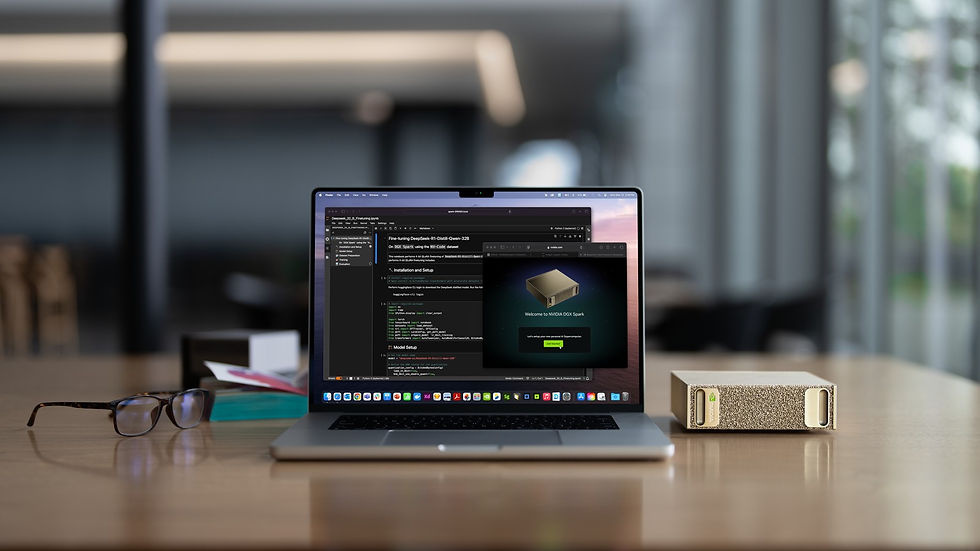
Chip: NVIDIA GB10 Grace Blackwell, 20-core Arm CPU, Blackwell GPU
AI performance: up to 1 petaflop at FP4
Memory: 128GB LPDDR5x unified memory, 273 GB/s
Storage: 4TB NVMe SSD with self encryption
Networking: 10GbE, Wi-Fi 7, ConnectX-7 SmartNIC
Software: NVIDIA DGX OS with the NVIDIA AI stack
Size: 150 x 150 x 50.5 mm, 1.2 kg, 240W adapter
As NVIDIA's own GB10 machine, it is the one the official playbooks are written for, a good fit for developers who follow the platform closely. Check the NVIDIA DGX Spark Founders Edition on Amazon.
What happens when every office has its own AI?
Local AI will likely become as common as a network printer within a few years. The price of entry is becoming more reasonable with the 64GB model, and open models keep getting smaller at the same quality. NVIDIA already lets up to four DGX Spark units work together on models of up to 700 billion parameters. A small business could soon host its own AI assistant on a machine it fully controls, the way it once ran its own file server.
That would shift the balance of power in AI. Cloud providers make money on every token, and they have less hold when customers stop paying for tokens. Founders building chatbots for lawyers, doctors or financial firms could sell software that runs entirely on customer premises, something cloud only tools cannot do. Investors are likely to watch which open models run well on these machines, since that shows what businesses can do offline.
It is not all good news. The memory shortage has pushed prices up, and the Founders Edition now costs far more than its original $3,999. Security also becomes the owner's problem. A misconfigured machine on an office network can leak as badly as a poorly secured cloud account, and nobody else is there to patch it.
Critics add that the best closed models are still available only in the cloud. A local 100 billion parameter model is capable, but it trails the big cloud models on hard reasoning tasks. Supporters answer that office work rarely needs the absolute best model. They argue that smaller models handle most summaries, drafts and internal search, which is much of what the token bill pays for.
Privacy rules could speed the shift. Limits on where client and patient data may travel already make cloud AI hard for some firms to adopt. A machine that never sends data out sidesteps that question.
Four things will show which way this goes.
Street prices for 64GB GB10 machines dropping below $4,000 during 2027.
New open models in the 100 billion parameter class that fit on one 64GB unit.
Office software vendors shipping on premises versions built for these machines.
Cloud AI providers cutting token prices to keep heavy users from buying hardware.
AI used to live only in distant data centers. Now it can sit next to the office coffee maker.
Subscribe to Sparknify for tech news and the people behind it.
Questions & Answers
Q1: I'm developing a private chatbot app for law firms that runs on local AI hardware such as the DGX Spark. Who is investing in software for local AI hardware?
Hardware makers are starting to fund the software that makes their machines useful. Phison, which counts MSI and ASUS among its partners, approved about $20 million to support independent software vendors creating applications for its aiDAPTIV technology. Phison's new venture arm shows what these investors are looking for.
Q2: Will desktop machines like NVIDIA's DGX Spark make large AI data centers in places like San Jose unnecessary?
Not anytime soon. Desk machines can run private chatbots and office tools, but training and the biggest models still need data centers. San Jose's city council approved a permit for an NVIDIA chip testing building that can draw 20 megawatts, a sign that demand for large facilities will continue.
Q3: How can a startup launching a local AI product based on the DGX Spark get access to investors and buyers in Silicon Valley?
The best place to start is where customers already are: technology events, founder programs and the trade press. One route is an introductory package with a planning session, a featured tech news article, an investor introduction and an invitation to present, available through the startup PR service at sparknify.com/startup-pr-service.


Comments