XREAL AURA Turns Android XR Into a $1,099 Pair of Glasses
Updated: 3 hours ago
A computer screen can now follow you onto an airplane tray table, a hotel desk or a living-room couch without being visible to the person sitting beside you. That is the promise behind XREAL AURA, the first wired glasses to launch with Google’s Android XR platform. Orders opened October 28 in the United States, Canada and Korea, with shipments expected in mid-November.
The launch price starts at $1,099 through the end of 2026. That buys more than a display strapped to a face: transparent glasses, a tethered compute puck, Google’s Gemini assistant and access to Android apps. It also introduces a practical question that specifications cannot settle alone. Is a private spatial workspace useful enough to make people carry another device and cable?
A screen that leaves the rectangle
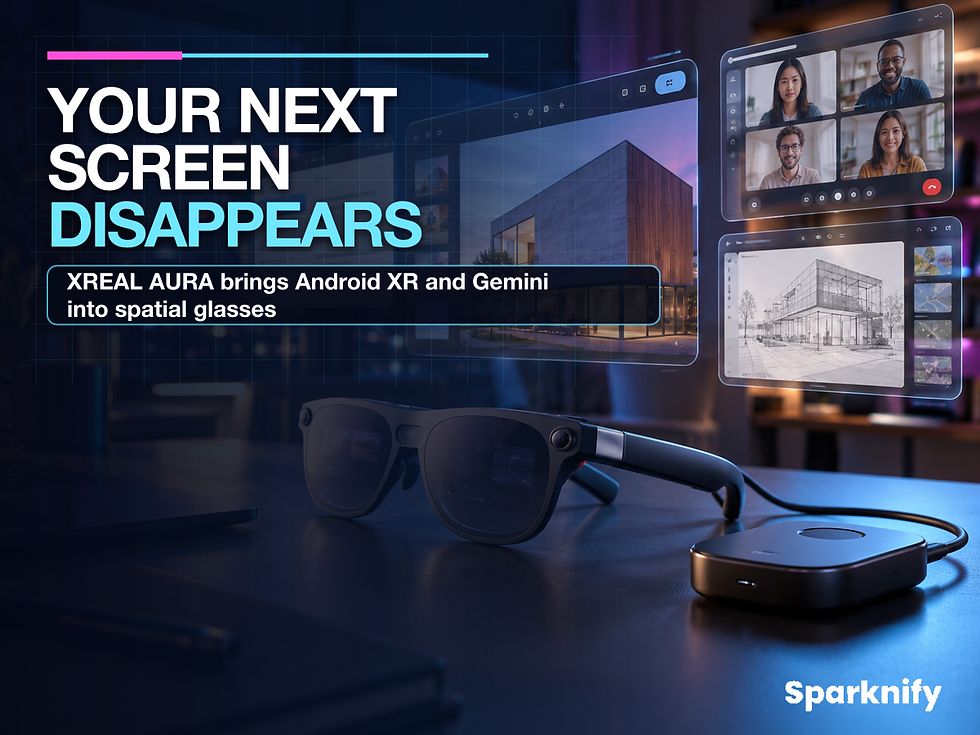
XREAL AURA uses optical see-through lenses, so digital windows appear in the wearer’s field of view while the real room remains directly visible. XREAL specifies a 70-degree field of view, Sony Micro-OLED panels at 1920 by 1200 pixels per eye, refresh rates up to 120 hertz and five levels of electrochromic dimming.
In Google’s official launch article, Shahram Izadi, the company’s vice president and general manager of XR, placed AURA at the front of the Android XR rollout:
“Today, together with XREAL, we officially launched XREAL AURA, the first wired XR glasses powered by Android XR.”
The word “wired” matters. These are not ordinary eyeglasses with an invisible computer inside. A cable connects the 95-gram glasses to a 265-gram puck that holds the battery, Android XR and Qualcomm’s Snapdragon Reality Elite processor. The split keeps heat and most of the weight away from the wearer’s face, but the complete system still has to be carried.
The puck is part of the product
XREAL lists two puck configurations: 12 gigabytes of memory with 256 gigabytes of storage, and 16 gigabytes with 512 gigabytes. The puck has a 4,455-milliamp-hour battery, active cooling, a fingerprint button and a touchpad. It supports keyboards, mice and game controllers over Bluetooth, while a second USB-C port accepts charging or DisplayPort video input.
That arrangement makes AURA a portable computer rather than a passive monitor. Android XR can place a browser, documents, music and other apps around the user. A laptop can also join through Wired Mirroring, with its screen appearing beside native Android windows without additional software.

The private-display angle may be the easiest benefit to understand. A person could open a large spreadsheet on a flight without exposing it to the next seat. Yet privacy is broader than shoulder-surfing. AURA includes outward-facing cameras, and Gemini can interpret what the wearer is viewing. Users should still examine account settings, view-sharing controls and workplace policies before placing confidential material in front of an AI-enabled device.
Gemini can see the work in context
Google says Gemini on Android XR can reason about the wearer’s surroundings and the apps in view. It can discuss a document, help arrange windows or highlight an object in the room or on a screen. That is a more ambitious interaction than opening a chatbot and describing what is happening somewhere else.
The idea echoes Sparknify’s recent look at Apple’s Creator Studio assistants, which move AI help beside a song, presentation or editing timeline. AURA pushes the same shift beyond a single application: the assistant can sit across several floating windows and the physical scene. The gain is context, while the obligation is clarity about what the assistant can observe and change.
Qualcomm’s June announcement explains why the hardware was built for that job. Snapdragon Reality Elite provides up to 48 TOPS of AI processing in the puck. In that official press note, XREAL co-founder and CEO Chi Xu described the earlier Project Aura as a practical bridge between spatial computing and daily work:
“XREAL Project Aura represents a new benchmark for optical see-through XR glasses, bringing powerful AI-driven experiences to both work and everyday life.”
That is the manufacturer’s ambition, not proof that every task improves in spatial form. The useful test will be whether Gemini reduces steps without distracting from the work already in view.
Entertainment may be the easier sell
AURA can dim its lenses and turn a seat into a private theater. Google TV, YouTube and other Android services can appear on a large virtual screen, while Spatial View can convert some ordinary photos, videos and games into 3D. Window Follow keeps content centered as the wearer moves and shrinks it toward the edge of vision when walking.

Google is also using the launch to expand immersive programming. The initial lineup includes Nevatars, co-directed by Andy Serkis and Josh Nelson Youssef; Galapagos: the Last Eden, narrated by Margot Robbie; and an XR presentation of San Francisco Ballet’s Nutcracker. Games built for spatial play include titles from Owlchemy Labs and Resolution Games, with Fallout Factions and Project Hail Mary: Journey Among the Stars among the announced additions.
Entertainment avoids some of the hardest productivity questions. A movie does not need a keyboard, and a private large screen has an obvious purpose in a cramped room. The remaining concerns are comfort over a full feature, battery life in actual use, app availability and whether the cable and puck become more noticeable than the virtual screen.
What the first buyers should measure
AURA orders are open to adults in the United States, Canada and Korea, with Japan scheduled for November 2. Google says the introductory price begins at $1,099 through December 31, and shipments start in mid-November. Buyers should compare the exact configuration, prescription-lens needs and return terms rather than treating the starting price as the cost of every setup.
The strongest launch claim is not that glasses have replaced the computer. It is that Android now has a serious spatial form factor with familiar apps, a purpose-built AI assistant and enough display area to try real work. The first reviews should measure how long people comfortably wear it, how often the puck needs charging, which apps behave well in space and whether Gemini’s contextual help earns the access it requires.
If those answers are convincing, the next personal computer may not be another rectangle on a desk. It may be the one that disappears when its owner takes off the glasses.
Earlier options remain available for buyers who want display-focused glasses without AURA’s complete Android XR setup, including the XREAL One Pro.
Subscribe to Sparknify for more tech news.


Comments