HPE Will Send Spaceborne Computer-4 to Run AI on the Moon Aboard FLIP
One of the first computers built to run modern AI models on another world will not be a rugged custom machine from a space agency. It will be a small, fanless box from Hewlett Packard Enterprise, bolted to a commercial rover near the Moon's south pole.
HPE announced on Tuesday, October 20, that its Spaceborne Computer-4 will fly on Astrolab's FLIP rover as part of NASA's Commercial Lunar Payload Services program, with a launch planned for late 2026. Once on the surface, it is set to run AI models, process mapping data and attempt what HPE calls the first high performance computing benchmarks ever run on the Moon.
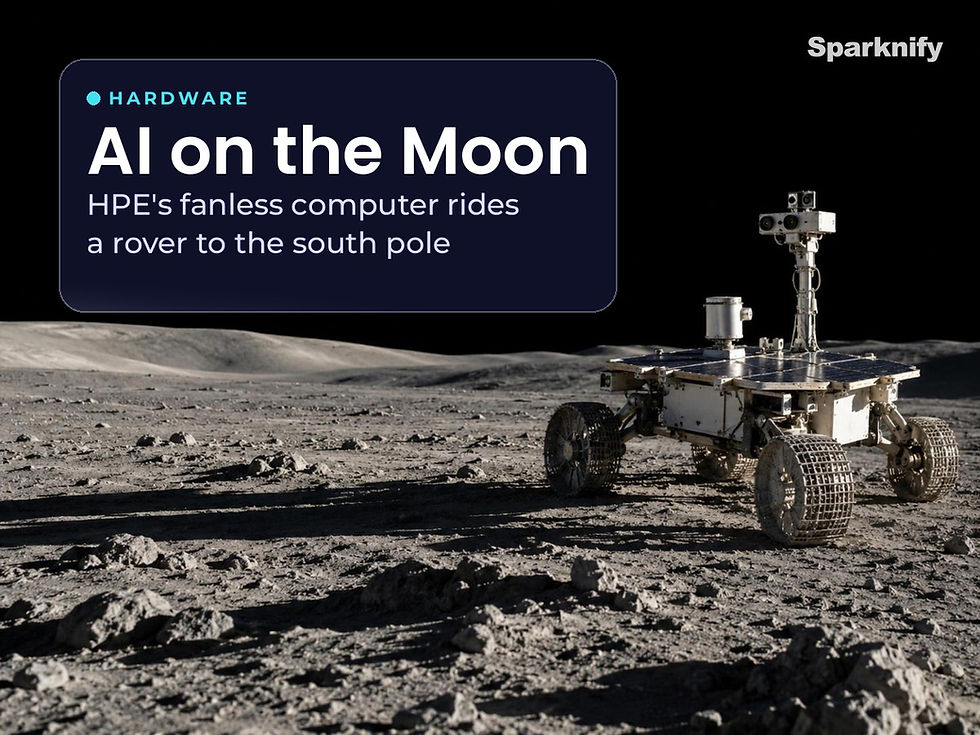
What HPE Is Sending to the Moon
Spaceborne Computer-4 is a lightweight, self-contained compute module designed for the lunar south pole. It has no fans, since there is no air on the Moon to carry heat away. Instead it ties into the rover's radiators and draws power from its batteries and solar cells. Inside are a low-power CPU and a GPU, which HPE has not identified, and solid state drives from Kioxia that hold the system's software and data.
HPE also built a software suite that manages how the module talks to computers on Earth and sends results home securely. Back on the ground, HPE Private Cloud and HPE CloudOps Software will support Astrolab's mission control in Hawthorne, California.
The module is the latest in a line of HPE machines built to test ordinary commercial computers in space. The first Spaceborne Computer launched to the International Space Station in August 2017 and passed one trillion calculations per second a month later, using software rather than radiation-hardened chips to protect itself. Its successor, Spaceborne Computer-2, began work on the station in 2021, and in 2024 HPE said it ran what it believes was the first large language model deployed in space. HPE chief executive Antonio Neri first announced plans for a Moon mission with Astrolab in June 2024. The lunar surface is a tougher test, with more radiation, wild temperature swings and nights that last about two weeks.
A Ride on FLIP
FLIP, short for Flex Lunar Innovation Platform, is an uncrewed rover from Astrolab, the Hawthorne startup that is also one of the companies NASA chose to develop a drivable rover for its Artemis astronauts. FLIP will ride to the Moon aboard the Griffin-1 lander and is designed to operate for about a year, surviving several lunar nights.
"We're sending the first supercomputer from HPE to the lunar surface later this year," Astrolab founder and CEO Jaret Matthews said at a media event at the company's headquarters on October 14. In HPE's announcement, he added: "The Moon presents a challenging environment for advanced computing, and we're pleased to provide HPE with an opportunity to demonstrate its technology on the lunar surface."
What the Computer Will Run
The headline experiment is a pair of classic supercomputer tests, High-Performance LINPACK and High-Performance Conjugate Gradient, the same benchmarks used to rank the world's fastest machines on Earth. HPE says no other organization has run them on the Moon.
Most of the remaining work looks more like everyday AI. The module will test retrieval-augmented generation with a large language model, so it can search and interpret documents stored on board, along with vision inference on camera images and LiDAR processing for mapping, navigation and terrain analysis. An AI services container will test how scalable AI applications can be deployed at what HPE calls the lunar edge.
Partners are bringing their own experiments. NASA will run FLUID, short for Federated Learning for Unbounded and Intelligent Decentralization, which coordinates three AI models trained on data from Earth, the Moon and the space station, as well as a tuned language model for searching onboard documents. Deloitte will test Silent Shield, a system that watches for cyber intrusions and unusual activity in near real time.
"The next chapter of lunar exploration will depend on the ability to turn data into insights at the point of discovery," Scott Wiest, a vice president and fellow at HPE, said in the announcement.

What It Means for Silicon Valley
HPE, now based in Houston, traces its roots to the Palo Alto garage where Bill Hewlett and David Packard started Hewlett-Packard in 1939, and it still has a large presence in the Bay Area. Kioxia, the flash memory maker whose drives are on board, runs its American business from San Jose. The mission is a reminder that the hardware Silicon Valley builds for data centers and laptops is now being asked to work on another world.
It also fits one of the biggest trends in AI hardware: moving inference out of distant clouds and closer to where data is collected. On the Moon, that is not a choice. Bandwidth back to Earth is limited, signals take more than a second each way, and a rover cannot wait for instructions every time it sees a rock. A computer that can sort through images and maps on its own and send back only the results could make lunar robots far more useful.
Interest in computing beyond Earth keeps growing. "One of the best use cases of GPUs in space is imaging," Nvidia CEO Jensen Huang said on the company's earnings call in February. Startups and large companies alike are now pitching orbital data centers and smarter satellites, and a working AI computer on the Moon would give that pitch real data.
Can AI Hardware Survive the Lunar Night?
The outlook is good. HPE has years of experience running commercial computers in orbit, and the low-power chips and flash drives in Spaceborne Computer-4 are close cousins of what goes into ordinary edge devices. If the module works, it would show that companies can send off-the-shelf AI hardware to the Moon instead of waiting years for custom, radiation-hardened chips that are slower and far more expensive. That could open the door for lunar landers, rovers and future bases to carry their own small data centers, and for Bay Area chip and software companies to sell into a new market.
Then again, there are real risks. Everything depends on a safe launch and landing, and recent commercial lunar missions have had a mixed record, with some landers tipping over or failing on the way down. Once there, the computer has to survive radiation, abrasive dust and nights of extreme cold on a tight power and thermal budget. HPE is relying on commercial parts and software protection rather than hardened chips, and no one will know how well that works until the system powers up on the surface.
There is also some skepticism about the mission's goals. Running a supercomputer benchmark on the Moon is a first, but skeptics point out that the score itself will be tiny next to machines on Earth, and that being first is partly a marketing achievement. HPE has also not said which CPU and GPU it is using, which makes it harder for outside experts to judge the results. Supporters answer that the point is not raw speed but proof that modern computing can live and work on the lunar surface, just as the first Spaceborne Computer proved the idea on the space station. There is a broader debate, too, over whether computing in space will ever make economic sense beyond niche missions, or whether it will stay a showcase for a few well-funded companies.
The signals to watch are specific. Will Griffin-1 launch and land on schedule before the end of the year? Will FLIP drive off and power up Spaceborne Computer-4 within its first days on the surface? Will HPE publish its benchmark scores and AI results, and name its chip partner? And will the module still be working after its first two-week lunar night?
From the Office to the Moon
At Sparknify we follow the shift toward running AI where the data lives. Yesterday we looked at Most Companies Use AI. Few Run on It. Phison Wants to Close the Gap, on how flash storage can help businesses run AI models on their own machines instead of rented cloud servers. Spaceborne Computer-4 is the most extreme version of the same idea: a small computer, fast flash drives and no easy line back to the cloud.
If it works near the south pole, local AI will have passed its toughest field test yet.
Subscribe to Sparknify for Silicon Valley tech news and the people behind it.


Comments