The Grocery Store Is Disappearing as these Startups Reveal the Future of Grocery: Robots, AI, and Invisible Stores
Amazon’s decision to shutter large portions of its Amazon Fresh physical retail footprint is more than a cost-cutting maneuver. It is a strategic signal, revealing a fundamental shift in how one of the world’s most data-driven companies now views the future of grocery retail.
For years, Amazon Fresh represented Amazon’s most ambitious attempt to reinvent grocery from the ground up. It introduced cashierless checkout, sensor-laden ceilings, computer vision-powered carts, and deeply integrated digital systems designed to remove friction from every step of the shopping journey. It was bold, futuristic, and technologically impressive. Yet despite this innovation, Amazon is now stepping back.
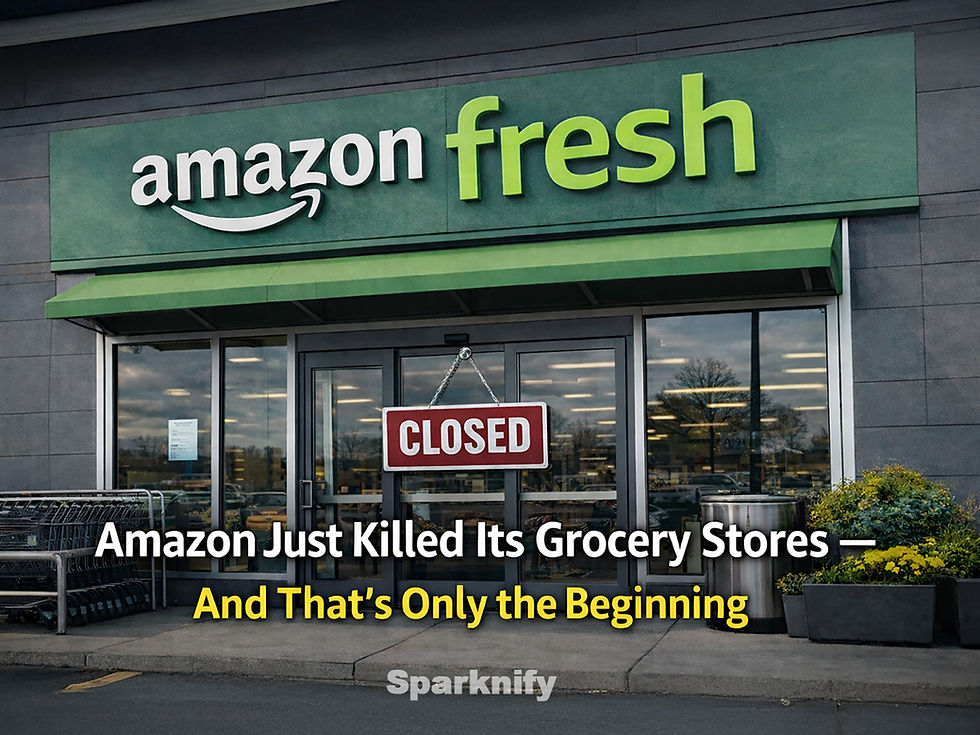
That retreat is not a sign of failure. Instead, it marks an inflection point. It reveals something far more important than store closures: grocery retail is entering a structural transformation, not just a technological one.
Why Amazon Is Walking Away from Amazon Fresh Stores
At first glance, Amazon’s pullback from physical Fresh stores seems counterintuitive. Grocery is a trillion-dollar global market. It is among the most frequent consumer purchases and represents a massive opportunity for customer data, logistics optimization, and cross-selling. Few companies possess infrastructure more capable of dominating grocery than Amazon.
Yet grocery is also one of the most punishing businesses in the world. Profit margins are extraordinarily thin, typically hovering between one and three percent. That leaves virtually no room for inefficiency. Every operational cost, whether from labor, spoilage, rent, logistics, inventory mismatch, or shrinkage, compounds rapidly. Amazon Fresh stores, with their heavy sensor deployment, advanced AI systems, and custom-built retail layouts, likely carried significantly higher operating costs than conventional supermarkets. While these stores showcased impressive engineering, their economics struggled to scale.
At the same time, technology alone failed to fundamentally reshape consumer behavior. While frictionless checkout is appealing, it did not radically alter how people shop for groceries. Most customers still want to browse aisles, inspect produce, compare brands, and make spontaneous food decisions. Grocery remains a deeply physical, habitual, and local experience. The marginal gains in convenience from advanced checkout systems proved insufficient to overcome that behavioral inertia.
Brand positioning also played a role. Amazon already owns Whole Foods, a premium grocery brand with strong consumer trust, established supply chains, and a mature operating model. Running parallel physical grocery strategies created internal complexity and market confusion. Consolidating around Whole Foods while repositioning Amazon Fresh primarily as a digital and delivery-first brand offers a far cleaner strategic narrative.
Most importantly, Amazon’s core advantage lies not in storefront retail but in logistics, data, and infrastructure. Warehousing, routing, predictive demand modeling, and last-mile delivery are where Amazon consistently outperforms the market. Physical grocery stores do not naturally amplify these strengths. By retreating from brick-and-mortar expansion, Amazon frees capital and organizational focus to double down on its most powerful moat: intelligent logistics systems.
From Retail Experience to Invisible Infrastructure
Amazon’s shift highlights a deeper transformation unfolding across the grocery industry. Grocery is no longer primarily a retail experience business. It is becoming a logistics and physical AI infrastructure business.
Rather than optimizing foot traffic, store layout, and checkout flow, the next generation of grocery competition will center on fulfillment speed, cost per order, inventory accuracy, last-mile efficiency, and real-time demand forecasting. In this emerging model, grocery stores become data-producing environments rather than mere points of sale. The physical store becomes a sensor network, feeding continuous operational intelligence into distributed systems that orchestrate fulfillment, pricing, and replenishment.
This evolution reflects a broader realization across retail: competitive advantage is shifting away from presentation and toward infrastructure.
Autonomous Grocery and the Rise of Physical AI Systems
For years, visions of grocery automation focused on robotic micro-fulfillment centers. These highly automated warehouses promised ultra-fast picking, reduced labor costs, and scalable e-commerce fulfillment. The engineering achievements were remarkable. Yet these systems also exposed grocery’s harsh economic reality. Heavy capital requirements, rigid infrastructure, and operational complexity made many of these models difficult to sustain outside of tightly controlled pilot environments.
As the industry matures, a more pragmatic and technically nuanced approach is emerging. Grocery innovation is increasingly being reframed not as a warehouse automation problem, but as a physical AI systems challenge.
Rather than replacing existing retail infrastructure, a new generation of startups is embedding intelligence directly into physical stores. Companies such as Veeve, Trigo, and Standard AI represent this shift. Their work illustrates how computer vision, edge AI, and real-time inference can transform grocery stores into continuously learning environments rather than static retail spaces.
Veeve: Intelligent Stores Without Rebuilding Them
Veeve exemplifies a deployment-first philosophy. Instead of redesigning entire stores, Veeve retrofits existing retail footprints with a dense network of cameras and edge compute nodes that enable checkout-free shopping and real-time inventory tracking. Their systems are designed to integrate seamlessly into current store layouts, minimizing capital expenditure and accelerating deployment timelines.
What makes Veeve particularly relevant is its focus on modularity and scalability. Rather than building monolithic automation systems, Veeve deploys distributed intelligence capable of adapting to diverse store formats, from small convenience outlets to large-format supermarkets. This approach allows retailers to modernize incrementally, avoiding the operational shock of full-scale transformation while still capturing meaningful efficiency gains.
In a margin-constrained industry, this ability to upgrade intelligence without rebuilding infrastructure is strategically decisive.
Trigo: Computer Vision at Global Retail Scale
Trigo represents one of the most mature implementations of computer vision-powered checkout-free retail. Its platform enables frictionless shopping by tracking products and customer interactions in real time, eliminating checkout lines while generating continuous inventory awareness.
Unlike early cashierless concepts that struggled outside tightly controlled pilot environments, Trigo’s systems have demonstrated the robustness required for real-world deployment at scale. By partnering with major global retailers, Trigo has shown that computer vision and AI can function reliably across diverse lighting conditions, store layouts, customer behaviors, and product assortments.
Trigo’s significance extends beyond checkout automation. The company’s real-time perception systems generate a persistent operational dataset that allows retailers to optimize shelf layouts, product placement, labor scheduling, and replenishment cycles. This turns the store into a continuously learning system rather than a static retail environment.
Standard AI: Edge Intelligence and Retail Analytics
Standard AI approaches grocery automation from an edge AI and analytics perspective. Its systems emphasize real-time perception, localized inference, and continuous operational optimization rather than centralized control architectures.
By processing intelligence directly inside the store, Standard AI minimizes latency, improves reliability, and reduces dependency on centralized cloud infrastructure. This edge-first architecture allows their systems to respond instantaneously to real-world events, whether tracking inventory changes, detecting shrinkage, or optimizing product placement.
Equally important is Standard AI’s focus on retail analytics. Beyond checkout automation, its platforms generate actionable insights into shopper behavior, store flow patterns, dwell times, and merchandising effectiveness. These insights enable retailers to continuously refine store layouts, promotions, and labor allocation, directly improving profitability in a business where incremental efficiency gains are decisive.
Together, Veeve, Trigo, and Standard AI illustrate a fundamental shift in grocery innovation: intelligence is moving from centralized warehouses into distributed physical environments. Rather than replacing retail, these systems quietly augment it, embedding AI directly into the physical fabric of everyday commerce.
Why Grocery Is Becoming a Testbed for Physical AI
Grocery is emerging as one of the most demanding proving grounds for physical AI systems. Unlike controlled factory environments or structured warehouses, grocery stores operate in chaotic, high-traffic, real-world conditions. Systems must function continuously amid human unpredictability, product diversity, frequent layout changes, and constant inventory churn.
As a result, grocery forces companies to solve some of the hardest problems in applied artificial intelligence. These include perception under ambiguity, continuous system uptime, real-time inference at massive scale, human-machine interaction, and deployment at ultra-tight cost thresholds.
The lessons learned here extend far beyond retail. They will shape how physical AI systems evolve across manufacturing, healthcare logistics, smart cities, warehouse automation, and autonomous facilities. In many ways, grocery is becoming the frontline laboratory for AI’s entry into the physical world.
Amazon’s Larger Strategy: Owning the Physical AI Stack
Viewed through this lens, Amazon’s retreat from Amazon Fresh stores becomes strategically coherent. Amazon is not abandoning grocery. Instead, it is repositioning itself to dominate the invisible infrastructure layer that governs fulfillment, delivery, and operational intelligence.
Amazon’s future grocery strategy is likely centered around predictive inventory systems, autonomous fulfillment orchestration, AI-driven demand modeling, hyperlocal delivery routing, and dynamic pricing intelligence. In this model, the store itself becomes a data node, feeding signals into a continuously learning logistics engine. The profit center shifts from retail transactions to operational mastery.
This is a far more scalable and defensible position. It aligns directly with Amazon’s historical strengths and allows the company to shape the foundational infrastructure upon which grocery ecosystems operate.
The Structural Reset of the Grocery Industry
The grocery industry is undergoing a structural reset driven by converging forces. Online grocery has permanently altered consumer expectations around convenience and delivery. Advances in physical AI have reached a level of maturity that allows reliable real-world deployment. At the same time, retailers face unprecedented pressure from rising labor costs, inflation, shrinkage, and operational complexity. Capital is increasingly flowing toward systems-level infrastructure rather than surface-level retail experiences.
Together, these dynamics are transforming grocery from a retail business into an intelligent logistics system.
Final Thought: The Grocery Store Is Becoming an AI System
Amazon’s closure of Amazon Fresh stores is not an admission of defeat. It is a recognition of reality.
The future of grocery will not be defined by who builds the most futuristic storefront, installs the most robots, or deploys the flashiest automation. It will be defined by who can design robust, scalable, real-world physical AI systems that integrate seamlessly into environments people already use.
Grocery stores are becoming living AI systems, continuously sensing, learning, and optimizing. The companies that master this transformation will not merely reshape how we buy food. They will define how artificial intelligence enters everyday physical reality.


Comments