The Prototype Trap: Why Most Hardware Startups Die Between Demo and Deployment
Updated: Mar 30
Every hardware founder remembers the moment when everything finally works. The prototype powers on without errors. The sensors respond exactly as planned. The robot arm moves smoothly. The system does what it’s supposed to do, in front of other people, without needing excuses or caveats.
It’s a powerful moment. Investors lean forward. Advisors smile. Someone inevitably says, “This feels real.” In that moment, the future feels obvious: refine the design, raise more capital, ship the product.
And yet, for many hardware startups, that moment marks the beginning of the most dangerous phase of the journey.
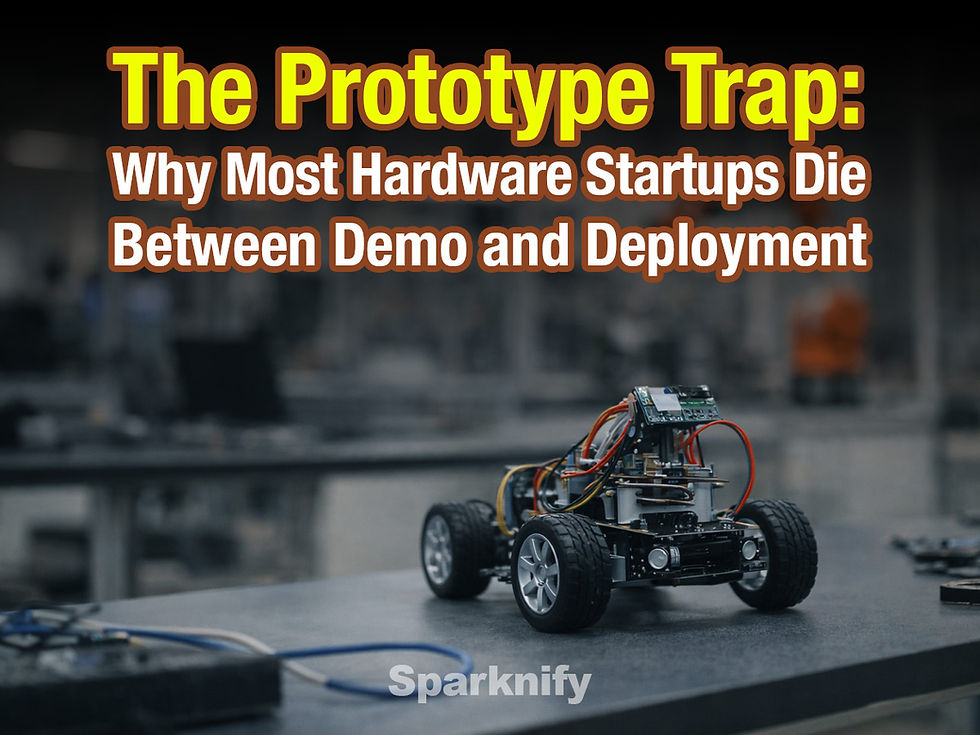
After the demo, progress often slows instead of accelerates. Manufacturing quotes come back higher than expected. Lead times stretch from weeks to months. New issues appear—issues that never showed up during the demo. What once felt inevitable begins to feel fragile. Momentum quietly drains away.
This is the prototype trap. It’s where hardware startups don’t fail loudly, but slowly, through delay, uncertainty, and erosion of confidence.
The Demo Is Not the Product
In software, a demo can often evolve directly into a product. In hardware, a demo is usually an exception—something that worked once under controlled conditions.
Early prototypes are built to prove feasibility, not durability. They are optimized for speed, not repeatability. Components are chosen because they’re available now, not because they’ll be available a year from now. Assemblies are hand-built by the people who designed them, not by technicians following standardized processes.
The demo answers only one question: Can this work at least once?
The product, however, must answer many harder questions: Can this be built the same way hundreds or thousands of times? Can it survive real environments? Can it be serviced, certified, and supported?
The danger is that success at the demo stage creates a false sense of readiness. Founders believe they’re closer to shipping than they really are—and underestimate how different the next phase will be.
Where the First Cracks Appear: Manufacturing Assumptions
The first serious problems usually appear when founders start thinking about manufacturing in concrete terms. Components that were easy to use during prototyping suddenly become liabilities. A chip that was perfect for development turns out to be nearing end-of-life. A connector isn’t rated for repeated use. A power component can’t meet efficiency or safety requirements at scale.
Lead times introduce another shock. Parts that arrive in days during prototyping may require 30, 40, or even 52 weeks once ordered in production quantities. Prices change dramatically at low volumes. Minimum order quantities force cash commitments far earlier than expected.
At this point, founders often realize that what they thought was a “final design” is actually just another prototype—one that can’t survive contact with manufacturing reality.
The Supplier Reality Check
Supplier relationships also change dramatically after the demo stage. Early conversations are often friendly and optimistic. Quotes are rough estimates. Timelines are flexible. Everyone wants to be helpful.
But once production enters the discussion, assumptions collide. The supplier expects higher volumes to justify engineering support. The startup expects guidance and iteration to be included. Quality standards, yield targets, and responsibilities turn out to be poorly defined—or never discussed at all.
Founders without manufacturing experience struggle to interpret what’s happening. Is this delay normal? Is this quote realistic? Is this supplier the problem—or is the design fundamentally unready? Without clear answers, decision-making slows, and confidence erodes.
The Thermal Surprise Nobody Budgeted For
Thermal issues are among the most underestimated—and most destructive—problems in hardware startups. A system that runs perfectly for a short demo can fail catastrophically when run continuously.
Heat accumulates. Performance throttles. Components drift out of spec. Batteries degrade faster than expected. Plastic enclosures warp. Sensors lose accuracy. None of these issues are obvious during early demos.
Thermal behavior is not a single-component problem; it’s a system-level outcome influenced by layout, enclosure design, materials, airflow, and usage patterns. Once mechanical and electrical decisions are locked in, thermal fixes become expensive and disruptive.
By the time thermal problems are obvious, the startup is often too far along to fix them easily.
Certification: The Silent Runway Drain
Certification rarely excites founders—but it can quietly kill startups. Safety testing, electromagnetic compliance, and regulatory approvals often enter the picture late, after a design feels “finished.”
When certification testing fails, the consequences ripple outward. Shielding changes require new layouts. Material substitutions affect thermal performance. Enclosure changes impact assembly and cost. Each iteration consumes time, money, and focus—without producing visible progress.
Because certification work doesn’t show up in demos or marketing materials, it often feels like dead time. In reality, it’s one of the most common reasons hardware startups miss deadlines and exhaust runway.
Why Smart Teams Still Fall Into the Trap
The prototype trap isn’t caused by incompetence. It’s caused by incentives. Early-stage ecosystems reward speed, vision, and storytelling. Demos unlock meetings, capital, and attention. Manufacturability, reliability, and supply-chain discipline are invisible—until they become unavoidable.
Founders are encouraged to sprint before they’ve learned how to walk inside a factory. The result is predictable: momentum that can’t be sustained.
The Teams That Escape Think Differently
The startups that survive treat manufacturability as part of innovation, not as a later step. They make early decisions with long-term consequences in mind. They choose components based on lifecycle support. They consider assembly constraints while layouts are still fluid. They expect redesigns—and plan for them.
They also engage suppliers early for feedback, not just pricing. They ask uncomfortable questions: What breaks most often? What fails certification? Where do startups usually underestimate cost or complexity? The answers are often sobering—but invaluable.
Most importantly, these teams accept that compliance, thermal design, and supply-chain realities will shape the product. They don’t fight these constraints; they design within them.
Why Taiwan Changes the Equation
This is where many Silicon Valley hardware startups reach an inflection point. Local ecosystems excel at ideation, software, and early validation. But when products collide with physical reality—yield, tooling, reliability, heat—the learning curve steepens dramatically.
Taiwan functions not just as a supply chain, but as an execution ecosystem. It combines semiconductor leadership, precision manufacturing, thermal expertise, packaging know-how, and a culture deeply rooted in design-for-manufacturing. Engineers are comfortable telling founders hard truths early—before those truths become fatal.
For many startups, serious engagement with Taiwan marks the transition from fragile prototype to credible product.
How ICTGC Helps You Cross the Gap
The IC Taiwan Grand Challenge (ICTGC) exists to help startups navigate exactly this transition. ICTGC is not merely about prizes or funding; it’s about access to the people and processes that turn ideas into manufacturable reality.
Through ICTGC, founders gain exposure to Taiwan’s semiconductor and hardware ecosystem, mentorship focused on real-world deployment, and non-dilutive resources that reduce pressure to rush prematurely. Instead of learning manufacturing lessons through costly failure, startups can confront them early, with guidance.
ICTGC helps founders ask the right questions while there is still time to change course.
Why This Matters Right Now
Hardware, robotics, edge AI, and physical intelligence systems are entering a phase where execution quality matters as much as innovation. Investors are more selective. Customers expect reliability from day one. Supply chains are less forgiving than they were a decade ago.
The cost of falling into the prototype trap has never been higher—and the reward for avoiding it has never been greater.
The Hard Truth—and the Opportunity
Most hardware startups don’t fail because their ideas are wrong. They fail because the world beyond the demo is harsher than expected.
The good news is that the prototype trap is avoidable. With the right mindset, the right partners, and early exposure to manufacturing reality, startups can build products that survive—and scale.
The bridge from prototype to product already exists.
It runs through Taiwan.
And ICTGC is designed to help founders cross it—before momentum turns into regret.
If your startup is standing at that edge, this is the moment to step forward.
Where Taiwan Innovation Meets Silicon Valley Capital
If this is a topic that interests you, be sure to join us in person in Silicon Valley — Taiwan Innovation Spotlight is an exciting, high-signal gathering featuring a curated showcase of breakthrough companies and the people building what’s next, bringing together Taiwan’s top innovators with Silicon Valley’s leading investors and ecosystem builders.
Join us on May 8, 2026 at 6PM in Mountain View, California, and experience firsthand why Sparknify is known as one of Silicon Valley’s best event hosts—this is not one to miss.


Comments