From Bikini to Facekini: Why Covering Up Is the New Provocation
This article includes independently selected product examples. If readers choose to purchase through these links, Sparknify may earn a small affiliate commission. This does not influence editorial coverage or conclusions.
On a sticky summer morning in Qingdao, the shoreline reads like a surreal dress code. Swimmers step toward the water in long sleeves and gloves, some with towering visors, and then you notice the headline item: a bright, tight mask that covers the entire head and face, cut with holes for the eyes, nose, and mouth. It looks like a playful villain costume—until you realize it’s neither joke nor performance. It’s a facekini, and for the locals who wear it, it’s simply beach equipment.

At its most literal, the facekini is swimwear for your face: a full-head hood made from swimsuit-like material, built to protect the most exposed, hardest-to-cover part of the body. Internationally, it’s been treated as a meme. In China, it has become something more telling—a practical invention that collided with a powerful aesthetic preference and emerged as a cultural symbol.
A mask designed for the sun—and a little more
The facekini’s most obvious job is sun protection. Public health guidance increasingly emphasizes that the best UV defense starts with shade and clothing, using sunscreen on what you can’t cover—not as a permission slip to bake longer. The facekini is that philosophy taken to its endpoint: if you can cover it, cover it.
That logic explains why the facekini feels oddly modern, even if it looks alien in a viral photo. It also helps explain why it took off in a place where “beach culture” doesn’t always mean “sun worship.” In many Chinese settings, a day at the seaside is still a day you try not to tan—especially your face.
The beauty of being pale
The facekini sits comfortably inside a long-running beauty ideal across much of Asia: lighter skin as a shorthand for refinement, femininity, and status. Reuters has noted the cultural association directly—pale skin framed as delicate, while darker skin suggests outdoor labor. Researchers and clinicians discussing colorism describe the same mechanism in broader terms: social rewards and penalties attached to skin tone can shape everything from personal self-image to consumer behavior, including the use of skin-lightening products.
That’s where the facekini becomes more than UV gear. It becomes a wearable boundary around a standard: I’m here for the sea, not the tan.
The inventor’s story: jellyfish first, fame later
The facekini did not begin as a fashion prank. In a 2019 interview with Goldthread, inventor Zhang Shifan—then an accountant in Qingdao—explained that the original problem wasn’t aesthetics at all. It was jellyfish. “A lot of people came and told me they were being stung,” she said, so she started selling thin wetsuits that covered swimmers from neck to feet, and people found them effective.
The turning point came when a customer pointed out the obvious flaw. The suit helped, they said, “but it’s only done halfway”—what was missing was “your face and neck.” Zhang began looking for a way to protect the uncovered parts and landed on a piece of existing gear: a scuba diving hood. She modified it, adapted it for swimmers, and in 2004, the facekini was born—designed to guard against both sun and stings.
Zhang was candid about why the mask found a market beyond jellyfish. In the same interview, she tied its popularity to a preference for paleness, saying, in essence, that tanning happens easily and “being pale” is seen as prettier. The facekini didn’t invent the beauty standard; it simply offered an unusually effective tool for living inside it.

Then came the moment the world noticed. Zhang said she went to many trade shows, but in 2012, Reuters filmed her products—catapulting the facekini into international attention. The attention had teeth. “People thought we looked like masked thieves,” she recalled. She described 2014 as roughly the peak of the craze, and she admitted she was reluctant to do interviews until a friend urged her to do more media—and to pursue a patent—before copycats rushed in.
Criticism didn’t end the facekini; it redesigned it. Zhang described hearing a story about someone walking on the beach at night who saw two facekini wearers and froze in fear—until they started talking and the observer realized they were just people. In response, Zhang leaned into making the facekini look intentionally “designed,” including versions inspired by Beijing opera masks, which she said older customers liked. Function became fashion, and fashion became a kind of reassurance.
And if you visit Qingdao today and don’t see many facekinis? Zhang has an answer for that, too. Go early—around 6 to 8 a.m.—when the beach is mostly locals, and wearing one feels ordinary, not like performance art.
Three Facekini styles you’ll see online
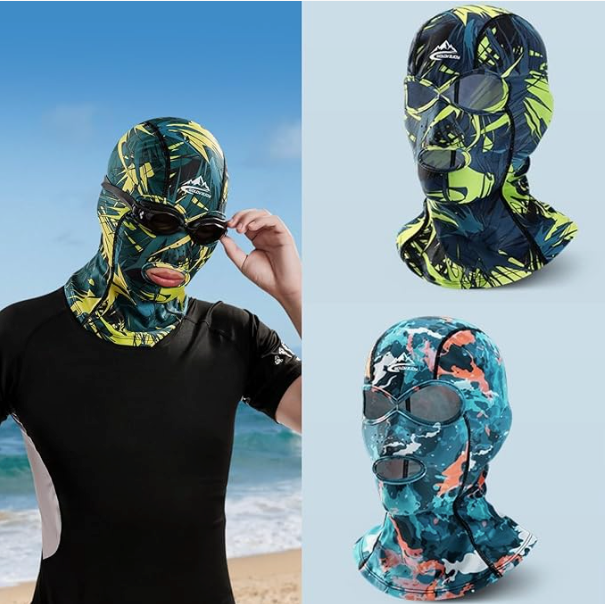
For anyone facekini-curious but not ready to commit to the full opera-mask moment, the online market tends to cluster into a few recognizable “looks,” ranging from swim-adjacent hoods to sports balaclavas that mimic facekini coverage. Below are three examples (with your Amazon links) that represent common style directions.
The first is the classic “beach facekini” silhouette: a full-coverage hood intended to keep sun off the face and neck while you’re outdoors. This is the style that most closely matches the original Qingdao beach aesthetic people associate with the trend.
The second style is the “statement” facekini — often brighter, more patterned, and closer to the Beijing-opera-inspired logic Zhang talked about: if it’s going to be a mask, make it unmistakably intentional. Stylistically, this is where many shoppers go when they want facekini as fashion, not just function. That design evolution shows up in both Zhang’s interview and Reuters coverage of opera-inspired versions.

The third style is the “facekini-adjacent” sports balaclava: it’s not culturally coded as beachwear in the same way, but it delivers the same visual punch and similar coverage. Your third link points to a multipack listing described as a 3-hole full face mask (two eye holes and one mouth hole), sold as a summer cooling neck gaiter / UV protector in polyester, with multiple colors included.
The fairness economy: beyond the mask

Once you understand the facekini as one expression of a larger ideal, it becomes easy to spot the ecosystem around it. There’s the “quiet” version of facekini logic—UPF clothing, parasols, giant visors, sleeves and gloves—tools that prevent UV-driven darkening before it happens, aligning neatly with mainstream sun-safety advice that prioritizes covering up and seeking shade. Sunscreen sits in the same toolkit, especially for uncovered areas, and dermatology groups commonly recommend broad-spectrum options with SPF 30+ as a baseline.
Then there’s the “instant” lane: cosmetics that brighten the look of skin without changing it—tone-up creams, luminous bases, and filters that quietly standardize what “pretty” is supposed to look like in a selfie. And finally there’s the high-stakes lane: skin-lightening products marketed to change pigmentation rather than simply prevent tanning or even tone.
That’s where beauty can become a health issue. The FDA has repeatedly warned consumers about skin products that may contain mercury, and it notes that mercury-containing creams, soaps, and lotions can cause serious harm. The World Health Organization has also highlighted global efforts—via the Minamata Convention on Mercury—to eliminate mercury-containing skin-lightening products, including restrictions on cosmetics above specific mercury limits.

Why the facekini endures
It’s easy to treat the facekini as a punchline—summer beachwear that looks like winter robbery prep. But its staying power comes from being a perfect cultural collision: a real invention solving real seaside problems, amplified by global media, and anchored to a beauty standard that many people live with daily. It can be sun safety, it can be fashion, it can be pressure—often all at once.
In the end, the facekini doesn’t just cover a face. It reveals a story about protection—against jellyfish, against UV, against aging, against judgment—and about how something as ordinary as a beach day can carry the weight of a standard: stay light, stay “refined,” stay unchanged by the sun.


Comments