Physical AI Is Exploding. Now the Robot Race Is Becoming a Geopolitical Battle
Updated: 1 minute ago
As Washington tightens scrutiny of foreign robots and venture capital pours into Physical AI, the next AI race is no longer only about who builds the smartest model. It is increasingly about who can build the machines, manufacture them at scale, and put them to work in the real world.
For most of the artificial intelligence boom, the action happened behind a screen. ChatGPT answered questions. Midjourney generated images. Coding agents wrote software. AI copilots summarized meetings, drafted emails and searched corporate databases. The defining battles of the first wave of generative AI were fought over models, GPUs, data and computing power.
Now AI is beginning to leave the screen. It is rolling down sidewalks, moving through warehouses, picking up packages, delivering meals and learning how to interact with the unpredictable physical world around us. That transition has given Silicon Valley one of its newest obsessions: Physical AI. Investors are pouring billions of dollars into robotics, autonomous systems and intelligent machines because they increasingly believe the breakthroughs that transformed software are about to transform hardware as well.
But there is one enormous difference between the Physical AI boom and the software AI boom that came before it. You cannot manufacture a robot in the cloud. A robot needs motors, sensors, cameras, batteries, actuators, wheels, processors, factories and a supply chain capable of producing all of those things at enormous scale. That is where the robotics race suddenly becomes much more complicated.
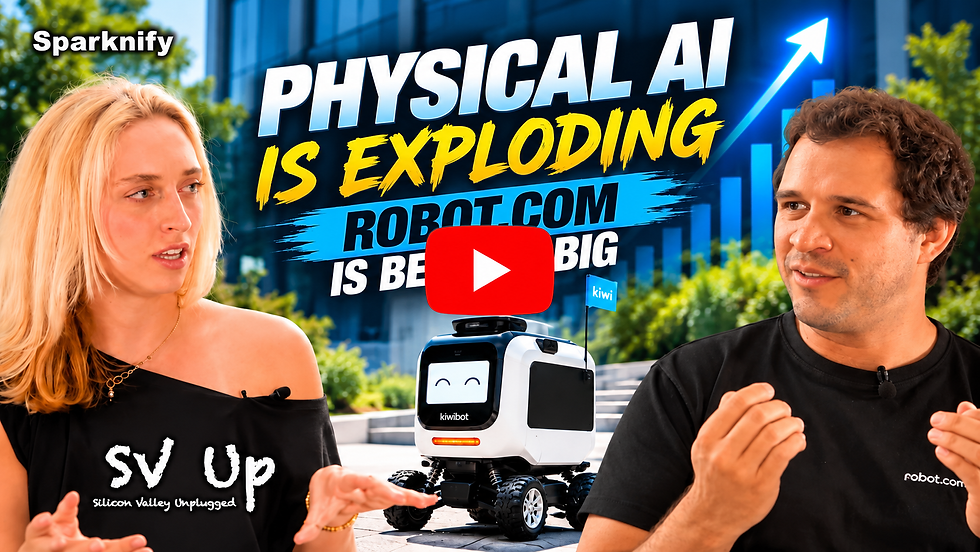
In the latest episode of Silicon Valley Unplugged, Sparknify Host Kelby Whitehead sits down with David Rodriguez, Cofounder of Robot.com, for a conversation about where robotics is heading and what happens as Physical AI moves from impressive demonstrations into actual businesses. One particularly important aspect of that discussion gets to the heart of what may ultimately determine who wins the global robotics race: the relationship between artificial intelligence, manufacturing and geopolitics.
The AI Race Is Becoming a Robot Race
The United States has already begun treating advanced robotics as more than another consumer technology category. In 2026, the Federal Communications Commission expanded national security scrutiny around certain foreign produced advanced robotic devices, including categories that can include humanoid, quadruped and other sophisticated autonomous systems. The move was widely interpreted as part of the broader American effort to reduce dependence on sensitive technologies connected to China.
The concern is not difficult to understand. A modern autonomous robot is not simply a machine that moves. It can see its environment, map physical spaces, communicate over networks, collect data, recognize objects and increasingly make decisions without constant human control. Put thousands of those machines inside warehouses, hospitals, factories, offices, airports and public infrastructure and robotics begins to look less like a gadget industry and more like a new layer of technological infrastructure.
That changes the geopolitical equation. Governments already treat semiconductors, telecommunications equipment, drones and artificial intelligence as strategically important technologies. Robotics is now beginning to enter the same conversation. The machines themselves may eventually become as important as the software intelligence running inside them.
This is a major shift because the first era of generative AI was largely a competition over intelligence. The emerging era of Physical AI is a competition over intelligence and industrial capacity.
Silicon Valley Has the Brain. But Who Builds the Body?
The United States has extraordinary strengths in artificial intelligence. American companies dominate much of the ecosystem surrounding advanced AI chips, foundation models, cloud infrastructure, simulation software and venture capital. Nvidia has become one of the most important companies in robotics computing. American AI laboratories continue to push forward perception, reasoning and planning systems that could eventually make robots dramatically more capable.
But intelligence is only one part of a robot. Machines also require motors, actuators, bearings, cameras, batteries, gear systems, sensors, control electronics and thousands of other physical components. They must then be manufactured, assembled, tested, repaired and deployed.
That is where China possesses a major structural advantage. Over the past several decades, China has built enormous industrial capacity across electronics, batteries, electric vehicles, motors, precision manufacturing and automation. Many of those capabilities transfer naturally into robotics.
Consider something as seemingly mundane as an actuator. An actuator is one of the components that allows a robotic joint to move. In a humanoid robot, actuators can control everything from shoulders and elbows to knees and fingers. They are not the part of robotics that generates viral videos, but they can represent a substantial portion of the cost and engineering complexity of the machine. A company may develop brilliant AI software in California, but if the physical components required to turn that intelligence into motion are expensive or difficult to source, the robot itself may never become economically viable.
That is the uncomfortable paradox sitting underneath the Physical AI boom. America may have some of the most advanced artificial intelligence in the world, while much of the manufacturing ecosystem required to give that intelligence a physical body sits across the Pacific.
Physical AI Is Changing the Venture Capital Equation
For years, Silicon Valley venture capital had a strong preference for software, and the reason was simple. Software scales beautifully. A startup can build a product once, place it on servers and sell it to thousands or millions of customers without manufacturing millions of individual units. Gross margins can be enormous, distribution can happen instantly, and updates can be deployed overnight.
Robotics has traditionally looked much messier. Hardware requires factories. Inventory consumes capital. Components become unavailable. Machines break. Customers need installation, maintenance and service. Deployment takes time. A software bug may cause an error message. A robot bug may cause a machine to crash into something.
Those realities kept many traditional venture investors cautious about robotics for years. Now the calculation is changing rapidly. Advances in computer vision, simulation, foundation models and robotic learning are convincing investors that the intelligence problem may finally be improving quickly enough to unlock the physical side of AI.
That is why Physical AI funding has accelerated so dramatically. Investors are beginning to believe that robots could follow a trajectory similar to software, where rapidly improving intelligence makes products more useful, broader deployment produces more data, and that data makes the machines even better.
Hardware is no longer being viewed simply as the expensive, difficult cousin of software. Increasingly, it is being viewed as the next place software is going.
For the last several years, entrepreneurs rushed to put AI into almost every category of enterprise software. The next generation of founders may spend the coming decade putting AI into almost everything that moves.
Robot.com Offers a Different View of the Robotics Boom
Robot.com is particularly interesting in this discussion because the company did not begin by trying to create a futuristic humanoid capable of doing everything. It began with something much more practical: autonomous delivery.
Originally known as Kiwibot, the company spent years placing small delivery robots into real public environments. Those robots had to navigate sidewalks, pedestrians, driveways, intersections, changing weather and countless edge cases that rarely appear in carefully staged robotics demonstrations. That experience matters because Physical AI faces a challenge that generative AI does not encounter in quite the same way. Reality refuses to cooperate with the demo. A robot can perform beautifully inside a controlled laboratory and then encounter an entirely different universe of problems once it enters the physical world. Someone leaves a bicycle across the sidewalk. A child runs in front of the robot. Construction suddenly blocks the route. A sensor becomes dirty. Wireless connectivity disappears. A pedestrian behaves unpredictably.
Each of those situations becomes another problem the system must learn to handle.
Robot.com says hundreds of its Kiwi robots have now completed millions of tasks across campuses and sidewalks. More importantly, those deployments have produced large amounts of real world navigation data. The company has also released datasets based on thousands of hours of sidewalk operation, giving researchers information collected not from simulation but from machines actually moving through public environments.
That distinction may become extremely important. In Physical AI, one of the most valuable assets may not simply be the robot itself. It may be the accumulated experience of millions of physical interactions.
Every Robot Could Make the Next Robot Smarter
The great advantage of many internet businesses was the network effect. More users generated more activity. More activity generated more data. More data improved the product. The improved product attracted more users, creating a powerful flywheel.
A similar flywheel may now be emerging in Physical AI. More robots create more real world interactions. More interactions produce more physical data. That data can improve navigation, perception and decision making models. Better models make robots more reliable, which allows companies to deploy more machines. Those additional machines then generate even more data.
Robot.com describes this idea simply: every task trains the next.
That concept helps explain why companies with years of deployment experience may have an advantage over newcomers with impressive demonstrations but relatively little real world operational data. A robot that has encountered tens of thousands of strange sidewalk situations may eventually become much better at handling situations that engineers never explicitly programmed.
The near future of robotics will also probably be more gradual than many people imagine. We may not suddenly wake up one morning to discover that robots have become completely autonomous. Instead, a machine may initially perform 70 percent of a task while humans handle unusual situations. Then it may perform 80 percent, then 90 percent. Remote operators may supervise multiple robots and intervene only when something unexpected happens. Over time, the edge cases become training data and the machine learns to handle more of them by itself.
The revolution does not need perfect autonomy to begin. It only needs robots to become useful enough, reliable enough and economical enough to deploy at scale.
This Is Where China Becomes Impossible to Ignore
If Physical AI enters a rapid scaling cycle, manufacturing capacity becomes one of the most important competitive advantages in the industry. A robotics company cannot survive on a great model alone. It must eventually produce physical machines at a price customers are willing to pay.
That price is determined by software, but it is also determined by factories, tooling, components, suppliers and production volume.
China has already demonstrated how powerful this combination can become. Electric vehicles provide one example. Batteries provide another. Solar manufacturing and drones offer similar lessons. Once a country develops dense networks of suppliers, experienced engineers, factories and component manufacturers, costs fall and innovation accelerates.
Robotics could follow the same path.
China already operates an enormous population of industrial robots inside its factories. That does more than automate manufacturing. It creates experience. Suppliers emerge around the industry. Component prices fall. Engineers become more specialized. Manufacturers learn how to build robotics hardware more efficiently. Startups gain easier access to parts, which allows even more companies to enter the market.
This creates an industrial flywheel that is extremely difficult to recreate overnight.
For Silicon Valley, that raises a provocative question. What happens if American startups possess world class artificial intelligence but struggle to access the world's most efficient robotics supply chains?
That may become one of the defining economic questions of the Physical AI era.
Restrictions Could Help American Robotics, But They Could Also Raise Costs
There are compelling arguments for Washington's increasingly cautious approach toward foreign robotics. Connected autonomous machines inside critical facilities could create legitimate cybersecurity and national security concerns. A robot equipped with cameras, sensors and network connectivity can potentially gather large amounts of information about the environment around it.
There is also an industrial policy argument. If American companies simply import inexpensive foreign robots, domestic manufacturers may never reach enough production volume to build their own competitive robotics ecosystem. Protecting the market could give American companies time to build manufacturing capacity, develop suppliers and create a stronger domestic industry.
But there is another side to the equation. Robotics supply chains are highly globalized. Even machines designed and assembled in the United States may rely on components produced throughout Asia and elsewhere. Restricting access to foreign suppliers too aggressively could raise costs for the very American robotics startups policymakers are trying to support.
The immediate result of separating the American AI ecosystem from Asian manufacturing may not automatically be inexpensive American robots. It could initially be more expensive American robots.
That tension is likely to define the next several years. The United States wants leadership in Physical AI, but achieving that goal will require more than better algorithms and more venture capital. It will require rebuilding parts of the industrial infrastructure needed to manufacture intelligent machines at scale.
The Biggest Robotics Winners May Not Build Complete Robots
This transformation could create opportunities far beyond the companies whose robots eventually appear in factories and homes. Some of the most valuable businesses in the Physical AI economy may never produce a complete robot.
They may manufacture actuators, motors, sensors, dexterous hands, batteries or cameras. Others may develop fleet management platforms, simulation systems, robot cybersecurity, remote operation technology, insurance, financing or specialized manufacturing equipment.
The smartphone industry created enormous businesses far beyond Apple and Samsung. Electric vehicles created opportunities across batteries, charging infrastructure, power electronics and manufacturing. Physical AI could produce a similarly broad industrial ecosystem. The machine that people see may only be the visible part of a much larger economy forming underneath it.
This is also why the current surge of investor interest matters. Venture capital is no longer looking only at the company building the futuristic robot. Investors are beginning to examine the entire stack required to make robotics practical, from intelligence and data to manufacturing and deployment.
The Real Physical AI Race Has Barely Started
For years, futurists have asked when robots would finally arrive. That may now be the wrong question. They are already arriving, just not necessarily in the dramatic form people imagined. Delivery robots are already moving through campuses and neighborhoods. Autonomous systems are operating inside warehouses and factories. Humanoid companies are racing to move beyond demonstrations into commercial deployment. Foundation models are learning how to understand physical environments, investors are pouring money into robotics startups, and governments are beginning to treat the industry as strategically important.
The fact that robotics has become part of international trade and national security policy may actually be one of the clearest signs that the industry has crossed an important threshold. Governments do not usually fight over technologies they believe are irrelevant.
Semiconductors became geopolitical. Artificial intelligence became geopolitical. Drones became geopolitical. Now robotics is heading in the same direction.
The next great AI battle may therefore look very different from the one Silicon Valley has been watching over the past few years. It may not be decided by which chatbot produces the best answer or which company develops the largest foundation model. It could be decided by which companies and countries can combine artificial intelligence with manufacturing, supply chains, real world data and large scale deployment.
That is what makes the conversation with David Rodriguez particularly timely. Robot.com has spent years dealing with the realities that disappear from many futuristic robotics videos: manufacturing, deployment, economics, autonomy, customers, sidewalks, edge cases and the difficulty of getting machines to perform useful work outside a laboratory.
In this episode of Silicon Valley Unplugged, Sparknify Host Kelby Whitehead sits down with David Rodriguez, Cofounder of Robot.com, to explore where this rapidly accelerating robotics industry is heading, how Physical AI is changing the technology landscape, and what happens as intelligent machines move from impressive prototypes into everyday life.
Physical AI is no longer simply a bet on what robots might eventually be able to do. The race to build them, manufacture them and deploy them has already begun.
Watch the full Silicon Valley Unplugged interview with David Rodriguez of Robot.com: https://youtu.be/aVTno96MDbU





Comments